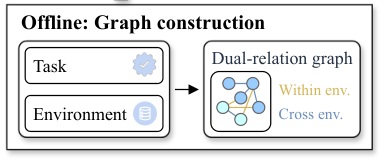
An agent-training task includes more than a prompt. Available tools, database state, transition rules and the verifier determine what the agent can learn from trying it. Selecting many apparently different questions can still concentrate training on a narrow set of environments.
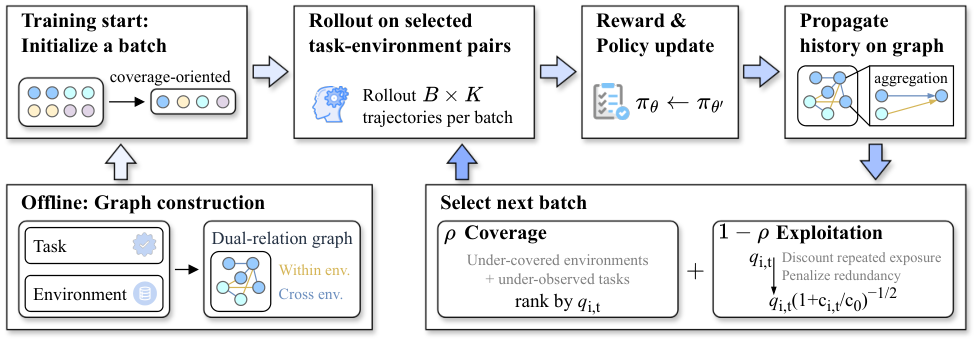
The October 27 EnvSched preprint, from a multi-institution research team including Peking University, proposes scheduling environment–task pairs using rollout history. It combines predicted reward variation with coverage of underobserved environments. The authors report that Qwen3-8B reaches a 48.81 average across three named agent benchmarks after 40 steps, exceeding their random-selection baseline’s best result after 120 steps. Read the primary source.
What the evidence establishes
That is a comparison within the paper’s setup, not a general promise to cut every training budget by two thirds. Environment construction, verification cost, model choice and the selection history all influence the meaning of a training step. Wall-clock and compute measurements are needed before converting step counts into operational savings.
The mechanism addresses a practical tension. Concentrating on tasks with useful reward differences may produce a stronger learning signal, while repeatedly choosing similar environments can narrow the policy’s experience. The scheduler’s coverage terms make that tradeoff explicit rather than assuming informative tasks are automatically diverse.
What changes in practice
A team evaluating the approach should hold the rollout budget and environment pool constant, then inspect both aggregate outcomes and individual environment families. It should also preserve the schedule and verifier revisions. Otherwise an apparent curriculum improvement could be partly explained by changed tasks or a more permissive checker.
The near-term contribution is a testable way to allocate scarce interaction rather than merely generating more examples. A longer-term benefit would be training systems that retain broad tool and state coverage while spending less effort on redundant experience.
The evidence to watch
The next evidence is transfer to new environment pools, with overhead and verifier failures reported alongside task success. Until then, EnvSched is a research proposal with encouraging controlled comparisons, not a demonstrated efficiency guarantee for production agents.
Source organization: Peking University.
Original research figure
References
Questions, news tips or corrections? Contact [email protected].