A robot can fold napkins for a day and still need a person beside it. Someone must refill the input bin and clear the finished stacks. DYNA acknowledges that boundary in its own earlier deployment: autonomy on the folding task did not mean autonomy over the surrounding job.
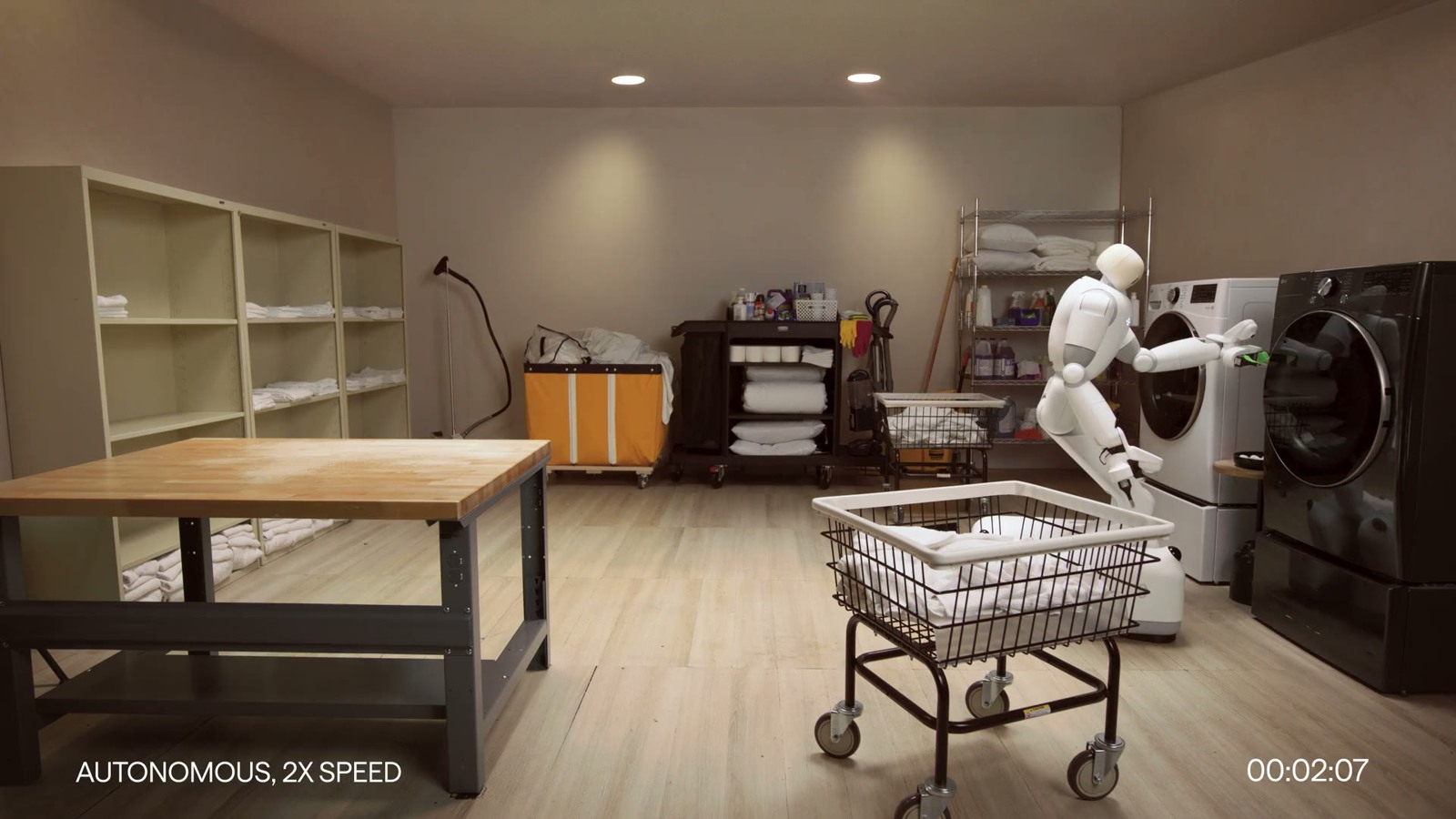
Its September 29 Dyna-2.1 announcement moves the claim from an isolated manipulation to a workflow. The company presents Taku, a wheeled semi-humanoid, executing an hour-long laundry sequence in uncut footage. The interesting engineering question is how folding continues while washers finish, loads change and the next useful action depends on something observed long before.
Three decision speeds share one robot
The stack separates responsibilities. A whole-body controller trained with reinforcement learning turns target poses into joint targets and wheel velocities at 100 Hz. The Dyna-2 world-action policy supplies trajectories. Above them, a vision-language orchestrator tracks the workflow and chooses the next step at a slower rate.
That hierarchy matters because not every decision needs to run at motor speed. Choosing which dryer to unload can use more context and time than tracking a wrist target. A larger reasoning model could therefore replace the orchestrator without requiring the controller to wait for every token. This is a design option described by the company, not a demonstration that all replacement models behave equivalently.
The important memory is local to the shift
Pretraining can supply general knowledge about laundry, but it cannot contain which washer was started here this morning. The orchestrator compresses visually observed progress into text: machine states, completed steps and towel counts. That retained state lets the robot resume folding after attending to another station.
The distinction is easy to miss in robot-memory claims. A stronger policy may know how to operate a dryer while lacking evidence that this particular load is ready. Workflow reasoning needs both procedural knowledge and a current account of events. Evaluating only isolated skills would not expose errors in the latter.
A stable motion interface keeps old data useful
DYNA’s Unified Robot Representation describes wrists, elbows, chest and footprint in task space. Human recordings and robot demonstrations can enter through that interface, while the controller handles the conversion to the current machine’s joints. The company also conditions the policy on controller metadata to account for different dynamics.
This gives the programme a second continuity problem to solve. Training data should survive a hardware revision, not become obsolete whenever the robot changes. A stable action format can help, but it does not erase differences in reach, response or sensing. The explicit controller context is an acknowledgement that equivalent command labels can still produce different physical motion.
Recovery matters more as the chain gets longer
The laundry example contains interruptions and recoverable mistakes, rather than a simple fixed list. A towel can be dropped; two can be grasped together; a finished machine can require attention while another task is underway. The system must identify the changed state and choose whether to repeat, recover or revise the plan.
The company’s uncut demonstration supports the shown execution. It does not provide an independent fleet-wide reliability estimate. Its announced next milestone is to take this new full-stack system to customer sites. Earlier commercial evidence for stationary folding should not be presented as proof that Dyna-2.1’s complete laundry workflow is already deployed at the same scale.
The product test is the handoff interval
A useful customer evaluation would measure how long the system works before a person must intervene, including replenishment, clearing, error recovery and machine scheduling. It should also record the cost of the interventions that remain. Otherwise a high manipulation-success rate can hide the operator still doing the connective work.
Dyna-2.1 makes that connective work visible in the architecture. The model that chooses a step, the policy that performs it and the controller that realises the motion are separate contributors. The commercial opportunity is a longer unattended handoff, while the evidence needed is longer and more representative workflow testing—not simply another increase in the success rate of a fold.
Read DYNA Robotics’s official announcement and demonstrations.
Questions, news tips or corrections? Contact [email protected].