A controller can reach a goal while holding a misleading picture of the environment. That distinction matters when a learned model is also supposed to explain a physical process: success at steering is evidence about the task, while faithful prediction is evidence about the system.
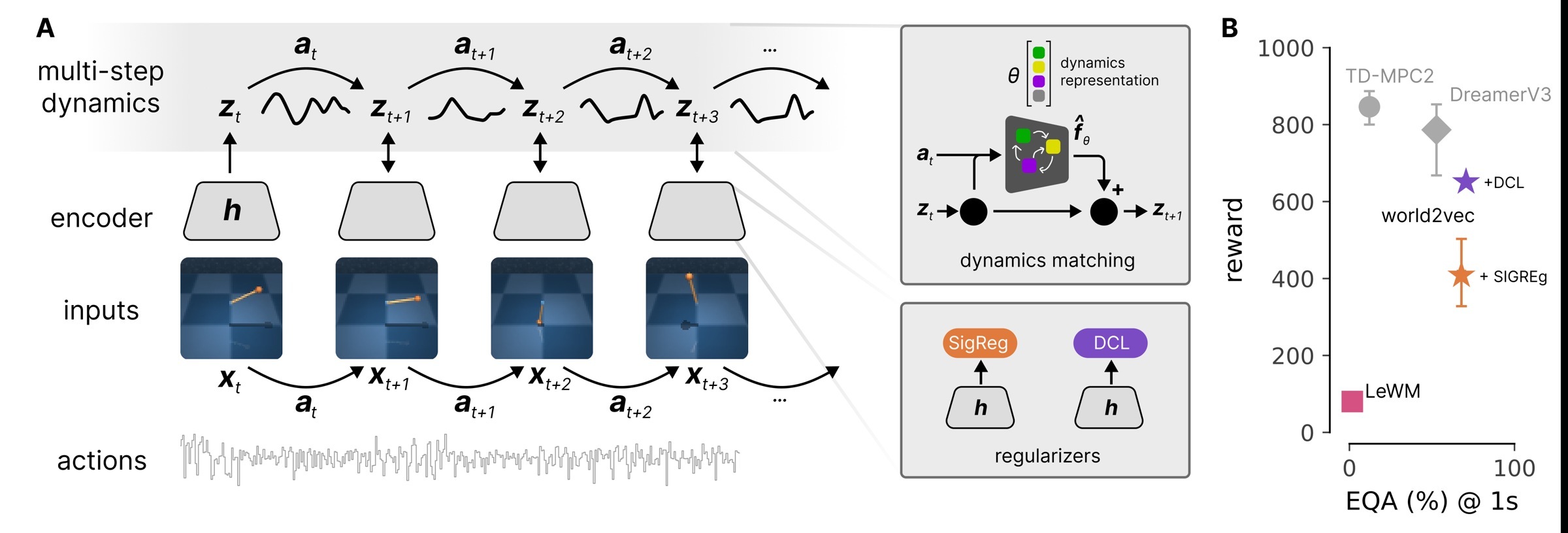
Helmholtz Munich and Munich Center for Machine Learning researchers introduce world2vec in an October 29 preprint. It learns from observations and actions without reward information, combining an encoder with action-conditioned latent dynamics. The authors compare it with DreamerV3, TD-MPC2 and LeWM, report at least an order of magnitude fewer parameters, and evaluate system identification across 71 attractors. These are research results under the paper’s conditions, rather than a general claim of validated physical discovery. Read the primary source account.
A representation has to preserve change
The central question is whether the learned coordinates preserve the evolution of the original state. Compressing an observation is insufficient if different physical situations collapse into representations that predict the same future. A useful latent model needs to retain distinctions that affect what happens next, including the consequences of actions. The paper makes this requirement explicit rather than relying on a task reward as its only diagnostic.
Its dynamics component uses a neural ordinary differential equation. This gives the learned state a continuous evolution rule, and the authors examine whether that rule reproduces the underlying process over longer prediction horizons. The form is relevant to interpretation, but an equation fitted by a neural model does not automatically identify a unique causal mechanism. The observations, assumptions and tested systems still delimit the inference.
Control quality and identification need separate records
The immediate value is an inspectable comparison between compact dynamics learning and established world-model approaches. A team choosing a model can ask two questions separately: does it support the desired action, and does its account of change remain accurate away from the action sequence that earned a good score? Reporting only the first can hide a model that is useful for one policy but misleading for another investigation.
For scientific use, a stronger transfer test would retain held-out interventions and prediction horizons, then compare observed and predicted trajectories. That is a proposed way to assess reuse, not a result independently reproduced here. It would help distinguish an economical representation of the evaluated environment from a mechanism that generalizes to new conditions.
Compact models could make repeated system identification easier to inspect and less expensive to run. Their broader contribution depends on preserving the link between representation, dynamics and observations as the setting changes. The decisive next evidence is accurate prediction under new interventions, with failures reported alongside successful control.
Source organizations: Helmholtz Munich, Munich Center for Machine Learning.
References
Questions, news tips or corrections? Contact [email protected].