Together AI’s compiler work treats inference optimization as a continuing response to changing workloads. Its November 4 report describes agents proposing optimizations while persistent inference engines make experiments faster to run. The important system question is whether a candidate that wins a short performance test remains correct and useful as traffic, concurrency and hardware conditions change.
Faster experimentation is the enabling claim
The Together Compiler report describes engines that stay loaded while candidate forward passes are replaced, reducing repeated startup work. It combines faster partial-engine tests with slower, higher-fidelity measurements. The company reports improvements of up to 2.6 times tokens per second across selected frontier-model settings. This is a reported maximum under specified comparisons, not an expected gain for every customer request.
The report emphasizes that input distributions affect optimization. Sequence lengths, mixture-of-experts behavior, cache conditions and concurrency can all change which implementation performs best. A fast isolated kernel therefore does not necessarily produce a faster complete inference service. The measurement environment is part of the claimed result.
The optimization target must match the service
Tokens per second is useful, but a serving system also has latency requirements, resource limits and quality expectations. An optimization that increases aggregate throughput can still be unsuitable if it worsens the delay experienced by a particular user group. Evaluation should retain the service constraints that matter rather than optimizing one headline metric in isolation.
Traffic drift creates a second challenge. A candidate selected on yesterday’s workload may not remain the best choice after a new model or usage pattern arrives. A continuing system needs to identify when its measurements are no longer representative. It should also distinguish a true performance change from ordinary variation in shared infrastructure or request mix.
Correctness testing belongs before performance promotion. A numerically different implementation may be acceptable within a defined tolerance, but that tolerance needs to be explicit and appropriate to the model. Tests should cover representative inputs and less common conditions. The speed of generating candidates should not outpace the capacity to verify their behavior.
For customers, this suggests a more precise way to assess optimization claims. Ask which traffic shape, hardware and service constraint produced the gain, and how the system behaves when those conditions change. A reported maximum can establish an interesting capability without establishing the average benefit across a production fleet.
Keep the performance record reproducible
A useful evaluation artifact would identify model revision, hardware, engine configuration, workload distribution and the baseline used. It would distinguish warm-up, steady-state measurement and the cost of the optimization process itself. Otherwise an apparent serving improvement may omit the resources spent searching for it.
Deployment should preserve an attributable configuration history and a tested rollback path. If a new candidate causes a regression under a rare traffic pattern, operators need to know which requests used it and how to restore the previous behavior. Those controls make continual change easier to operate without treating every new candidate as a permanent commitment.
Together’s report establishes a concrete approach to increasing optimization throughput and reports substantial results in selected settings. The next stronger evidence is repeatable improvement over changing production workloads with correctness, tail behavior and optimization cost reported alongside speed. That is the level at which an automated compiler becomes a dependable serving capability.
Sources and media credits
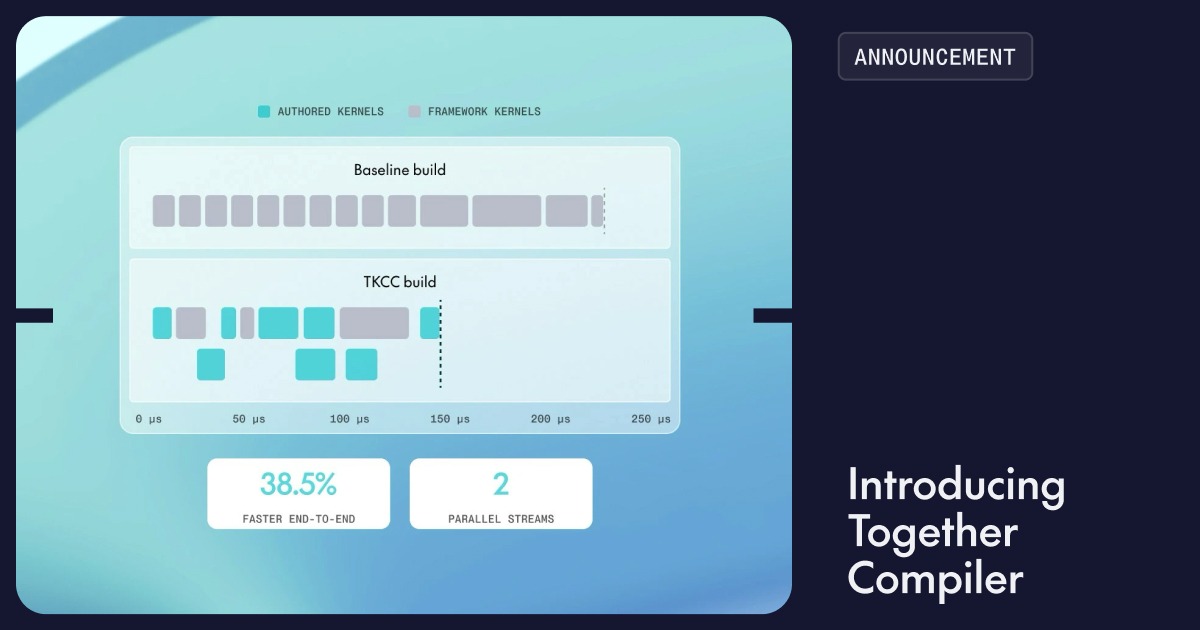
Together AI’s compiler release artwork. Supplier illustration of the optimization work. Image: Together AI