Skylark Labs’ humanoid EOD-search demonstration gives CFAM a concrete tool-use setting: a robot learns a detector-handling sequence and reacts to the instrument’s signal under supervision. For frontier AI, the interesting claim is the relationship between a stable learned model and new experience stored during use. The demonstration should be evaluated separately from benchmark results reported for the broader architecture.
Distinguish the demonstration from the research
The company-authored sponsored Breaking Defense article describes supervised humanoid search using a standard handheld detector. It does not publish an independent EOD trial or a detection-error study. Its discussion of roughly 30% higher task success refers to separate manipulation testing, rather than a measured improvement in explosive-hazard search. Those results should not be transferred to the demonstration.
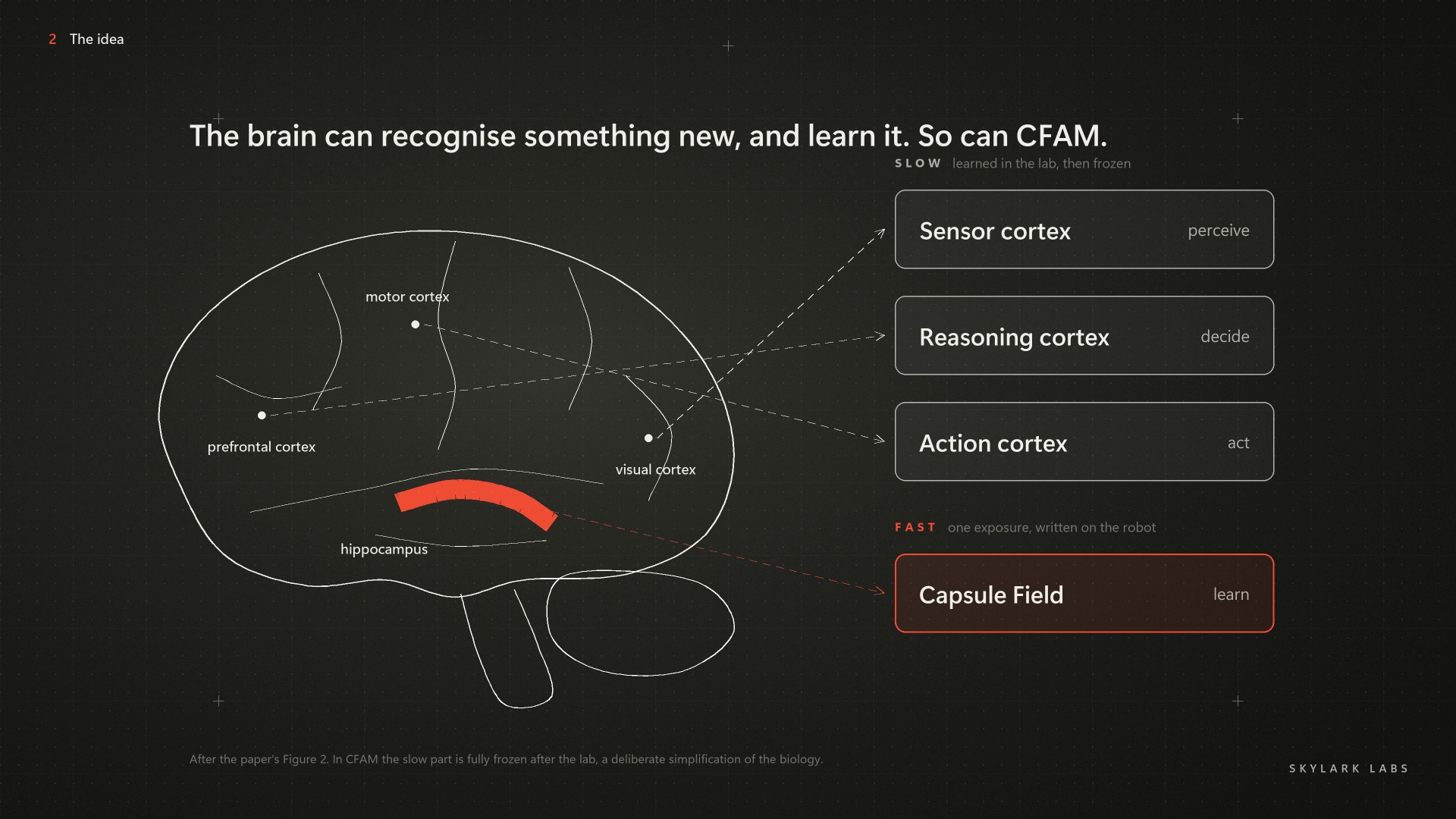
The CFAM research paper describes a slow component containing sensor, reasoning and action cortices, alongside a fast Capsule Field storing verified competence capsules. The described test-time updates are gradient-free changes to that memory mechanism. They should not be reported as unrestricted retraining of all model weights during an uncontrolled field operation.
Learning requires an acceptance rule
The word verified carries much of the architectural responsibility. New experience can be useful only if the system has a defensible way to decide what it represents. A successful-looking movement may coincide with an incorrect tool reading or an unnoticed intervention. The acceptance process needs to distinguish those cases before experience becomes reusable competence.
The paper reports experiments across several embodiments and tasks, including data-efficiency and adaptation comparisons. Those are research results under stated conditions. They do not establish that the same margins apply to a new instrument, environment or hazardous mission. An evaluation should retain the task distribution, baseline and verification method attached to each number.
For a physical system, adaptation also needs a record linking memory state to behavior. Reviewers should be able to identify which experience was accepted, when it became available and whether it influenced a later action. That supports diagnosis when a robot improves on one task but behaves unexpectedly on another.
The EOD-related demonstration makes those questions tangible because tool use and interpretation remain distinct. A robot can learn to manipulate a detector without proving that its indications are sufficient for a specialist decision. The analysis should therefore assess the learned sequence and its supervision separately from the instrument’s detection properties and the human’s final judgment.
What a stronger adaptive-learning test would show
A useful evaluation would compare a fixed starting system with the same system after specified verified experiences. It would report new-task performance, earlier-task retention, rejected experiences and interventions. A held-out test would examine transfer beyond the exact demonstration, while preserving clear limits on the environment and permitted actions.
Rollback is part of that evidence. If a new memory entry produces an unwanted effect, operators need a way to identify and remove its influence without losing the entire operating record. The cost of verification and supervision should also be measured; a learning gain that requires extensive specialist review has a different deployment profile from one requiring little additional attention.
The present material connects a company-reported physical demonstration with a documented adaptation architecture. The next persuasive milestone is an independently reviewable test showing useful new competence, retained earlier behavior and traceable memory changes. That would establish a stronger bridge between CFAM’s research claims and dependable robotic operation.
Disclosure
Skylark Labs supplied the demonstration media. This publication has no ownership or employment affiliation with Skylark Labs and has not independently reproduced the reported performance.
Sources and media credits
Conceptual CFAM architecture diagram from Skylark Labs’ supplied animation, showing slow sensor, reasoning and action cortices alongside a fast Capsule Field. The diagram illustrates the proposed architecture. Media: Skylark Labs, company-supplied media.