A training example can look harmless to a reviewer while changing a model in an undesirable direction. Content filtering examines what the example says; data attribution asks how learning from it may affect behavior. That distinction matters when organizations adapt models on ordinary instruction data.
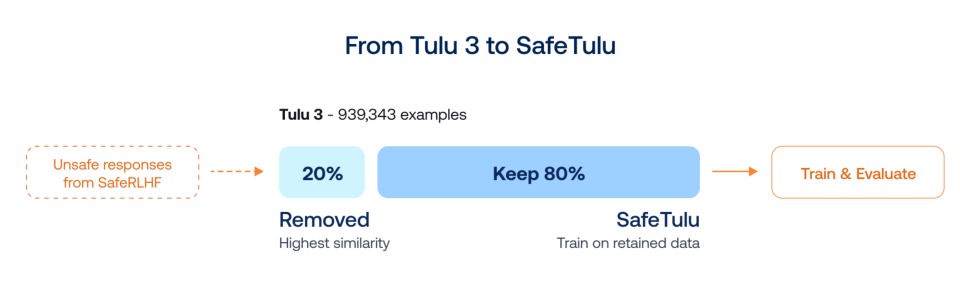
An October 27 preprint by researchers affiliated with DatologyAI and the University of Illinois Urbana-Champaign introduces SimpleLoRIF and SafeTulu. The authors use gradient embeddings to identify examples aligned with unsafe responses, then remove the highest-scoring fifth of Tulu 3. They report lower attack success across tested Qwen, Llama and Olmo configurations while largely retaining capability. Read the primary source.
What the evidence establishes
The proposal makes safety preservation a data-selection experiment. It does not establish that a fixed list of suspicious phrases can protect every model. The attribution score depends on the model representation and the unsafe behaviors chosen as references, so both should be preserved with the resulting dataset revision.
A receiving team would need to compare against meaningful alternatives: the unfiltered mixture, a similarly sized random removal and its existing selection process. Capability checks should include the tasks the organization values, rather than relying only on the benchmark average used in the paper. A reduction in one attack measure cannot stand in for a complete safety assessment.
What changes in practice
The method also changes the audit question. Instead of assuming that a benign label settles whether an example is appropriate, reviewers can examine groups whose estimated effects differ. That may help direct human investigation, but attribution is still evidence to test rather than a causal guarantee about each individual record.
The immediate opportunity is an additional, inspectable filter for post-training data. A longer-term curation process could track how selection decisions affect both desired behavior and regressions across successive models. That would require reproducible reference sets and independent checks beyond the released experiments.
The evidence to watch
The important next result is transfer: whether the same procedure improves held-out safety and useful capability under different model families, data mixtures and attack conditions. The paper is a preprint, and this publication has not independently reproduced its experiments.
Source organization: DatologyAI.
References
Questions, news tips or corrections? Contact [email protected].