

Source chronology: November 23, 2026. Analysis published 24 November 2026.
Robot learning results increasingly reflect a partnership between a model and the software that converts its decisions into action. SenseNova’s RoboRSI-27B release is useful because it makes that partnership visible. The opportunity is a system that can inspect new observations and recover from mistakes; the evaluation problem is deciding which part of the system produced the improvement.
The November 23 model card describes a 27-billion-parameter model, embodied post-training and changes to the execution harness. It reports improvements in RoboDojo simulation and small physical-robot trials. These are supplier-reported results. They show a research direction worth testing, while leaving substantial distance between a successful demonstration and dependable operation in unfamiliar facilities.
Training the policy and improving its surroundings
The release describes a loop that uses selected teacher rollouts and subsequent fine-tuning, alongside changes in how actions are executed and reviewed. Updating both can be sensible engineering. A better harness can give a model clearer observations or a more useful interface. It also makes a single headline score insufficient to identify the source of a gain.
A useful reproduction would retain the earlier model with the new harness and run the new model with the earlier harness. The complete release remains the practical product, but those comparisons reveal whether a deployment needs new weights, a software migration or both. They also help identify which component is responsible when a capability fails to transfer.
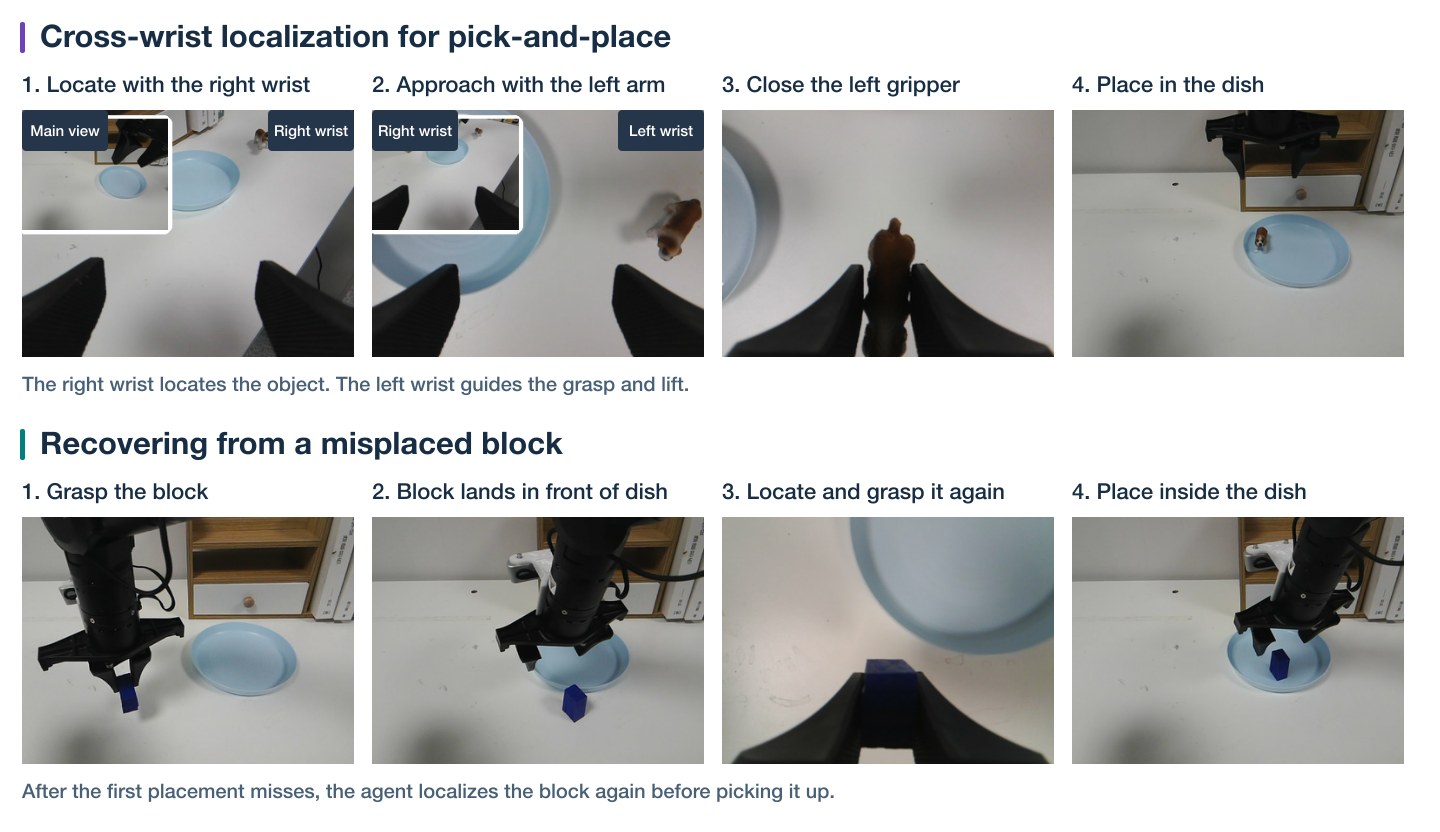
The physical examples deserve separate treatment from the simulation result. The card reports six successes in ten Piper pick-and-place trials and nine in ten PiperX stacking trials. Such counts are informative precisely because their denominator is visible. They are small samples of specified tasks, not a general measure of robotic competence or an estimate of reliability across many sites.
The card’s local-action comparison measures open-loop coordinate error. That can expose a useful interface improvement, but it does not measure whether a robot completes a task after multiple uncertain actions. A system can improve individual placements and still fail through accumulated errors, ambiguous observations or an unsuccessful recovery decision.
Recovery is where fresh observations matter. An evaluator should record whether the system recognizes a failed grasp, what it does next and how often an intervention ends the attempt. Counting only the final success can hide repeated risky or time-consuming behavior. Counting every interruption as failure can hide a cautious system’s useful ability to stop. Both the outcome and the path to it belong in the record.
The release’s statement about excluding real-robot data from embodied post-training also has a defined scope. It should not be expanded into a claim about every image or video used during all earlier training. Clear descriptions of training stages are more valuable than a broad label that obscures where evidence originated.
SenseNova indicates that a RoboDojo reproduction script is pending after leaderboard submission. Until the necessary materials are available and reproduced, the results remain a supplier account. Our assessment is that the model-and-harness framing is the strongest contribution: it encourages the field to ask whether a trained capability remains useful through the interfaces, interruptions and recovery decisions that determine actual robot behavior.