A dataset can be publicly downloadable and still be difficult to use. A researcher may need to discover what a field means, identify the version behind a result or determine whether two files describe comparable observations. An AI system combining resources encounters the same problem at a larger scale. Open access is therefore an entry condition for reuse, while documentation, provenance and workable formats determine what another team can actually build.
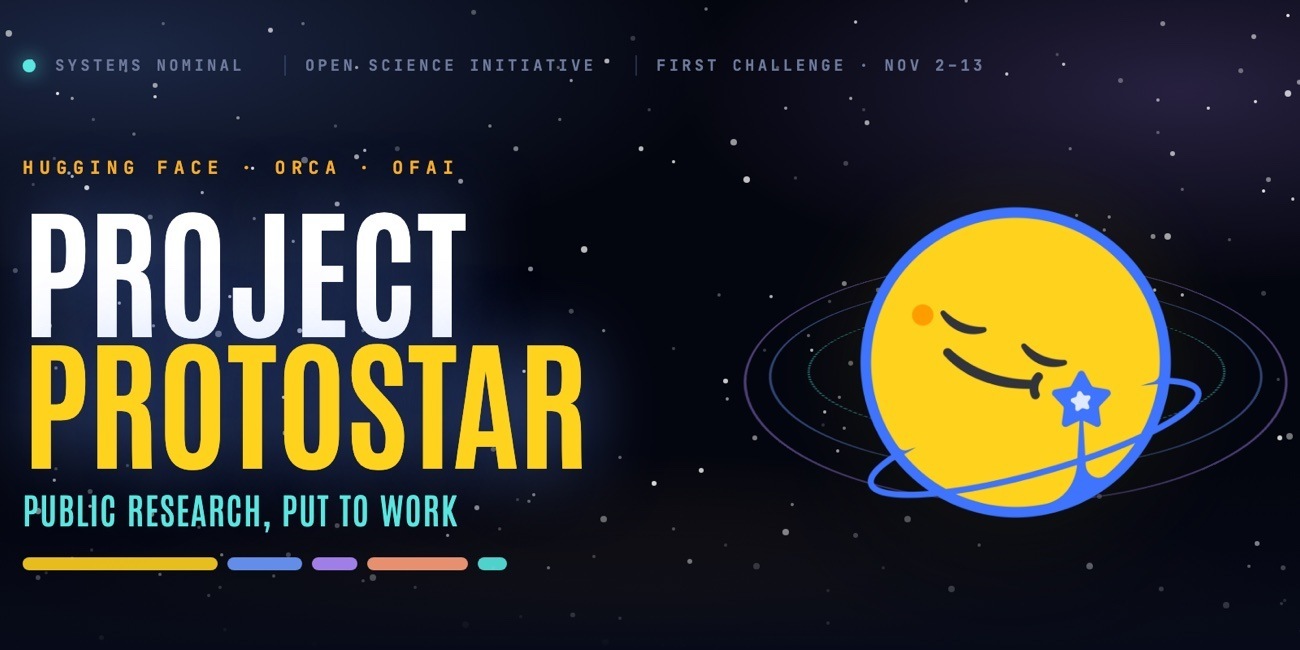
Project ProtoStar, announced on October 29, brings universities and research organizations together with Hugging Face, the Astera Institute and the Open Research Community Accelerator. Its stated purpose is to make publicly funded scientific datasets, models and code easier to discover and reuse through open infrastructure. Participation includes institutional commitments, and a series of challenges is intended to produce practical evidence about the barriers that remain. Read the primary source account.
The first challenge has a concrete observation window
Carnegie Mellon University will host the inaugural Climate Risk Intelligence challenge from November 2 to 13. The announcement describes weather records from 210 US cities, using information through 2018 to predict conditions from 2019 through 2026. Four indicators cover annual temperature, precipitation, the hottest day and cooling degree days. Comparisons will include historical averages and linear trends. Final forecasting results are expected in early 2027 after the full 2026 record becomes available.
That design makes an important distinction between a retrospective forecast and an assertion about unknown future weather. The held-out period contains observations against which predictions can eventually be checked. Researchers still need to preserve the boundary between information available to the model and information used for evaluation. A system that indirectly obtains later observations would be answering a different question from one restricted to the specified historical resources.
Reuse can fail before modeling begins
The initiative’s broader question is whether suitable scientific artifacts can be discovered, combined and extended. A failed attempt can be useful evidence if it identifies the obstacle precisely. An undocumented unit, a missing dependency or an ambiguous version creates a different problem from insufficient predictive signal. Recording those distinctions helps institutions improve the release itself rather than attributing every unsuccessful downstream result to the model used by a participant.
The challenge structure also separates forecasting from policy proposals. That matters because a numerical error measure cannot by itself establish the quality of an adaptation decision. A team may predict an indicator accurately while proposing an intervention that depends on assumptions outside the dataset. Keeping the outputs separate allows each to be assessed on appropriate grounds, instead of allowing a persuasive narrative to stand in for a measured forecasting result.
Baselines make added complexity accountable
Historical averages and simple trends provide reference points that readers can understand. They are useful precisely because an elaborate pipeline should have to justify its additional work. If a model improves one indicator but degrades another, the result should remain visible at that level. A single aggregate can obscure where a method helps and where it does not. The announcement establishes the planned comparison, not its outcome.
For institutions publishing artifacts, the immediate task is to make the release inspectable by someone who did not create it. That includes explaining the observation period, transformations, missing values and intended uses in a form that can travel with the files. A challenge can reveal which documentation another team actually needed, giving curators a more concrete feedback loop than a download count. Popularity and successful scientific reuse are different measures.
A further test is whether another team can repeat a submission after the challenge closes. That requires stable references to the input release and the transformations used, not only a link to a leaderboard entry. If the underlying artifact changes, an explicit version allows curators to improve it without silently changing the basis of an earlier result. This would turn the challenge into a reusable research record as well as a competition, and make lessons about documentation easier to carry into later institutional releases.
The longer-term possibility is a repeatable route through which publicly funded outputs support work beyond their original project. That depends on incentives, maintenance and the quality of the released material as much as the hosting platform. ProtoStar has announced a structure for testing that proposition. The first useful milestones are accessible challenge resources, reproducible submissions and a clear account of both successful reuse and remaining friction. Forecasting claims should wait for the evaluation that the coalition has scheduled.
Source organizations: Hugging Face.
References
Questions, news tips or corrections? Contact [email protected].