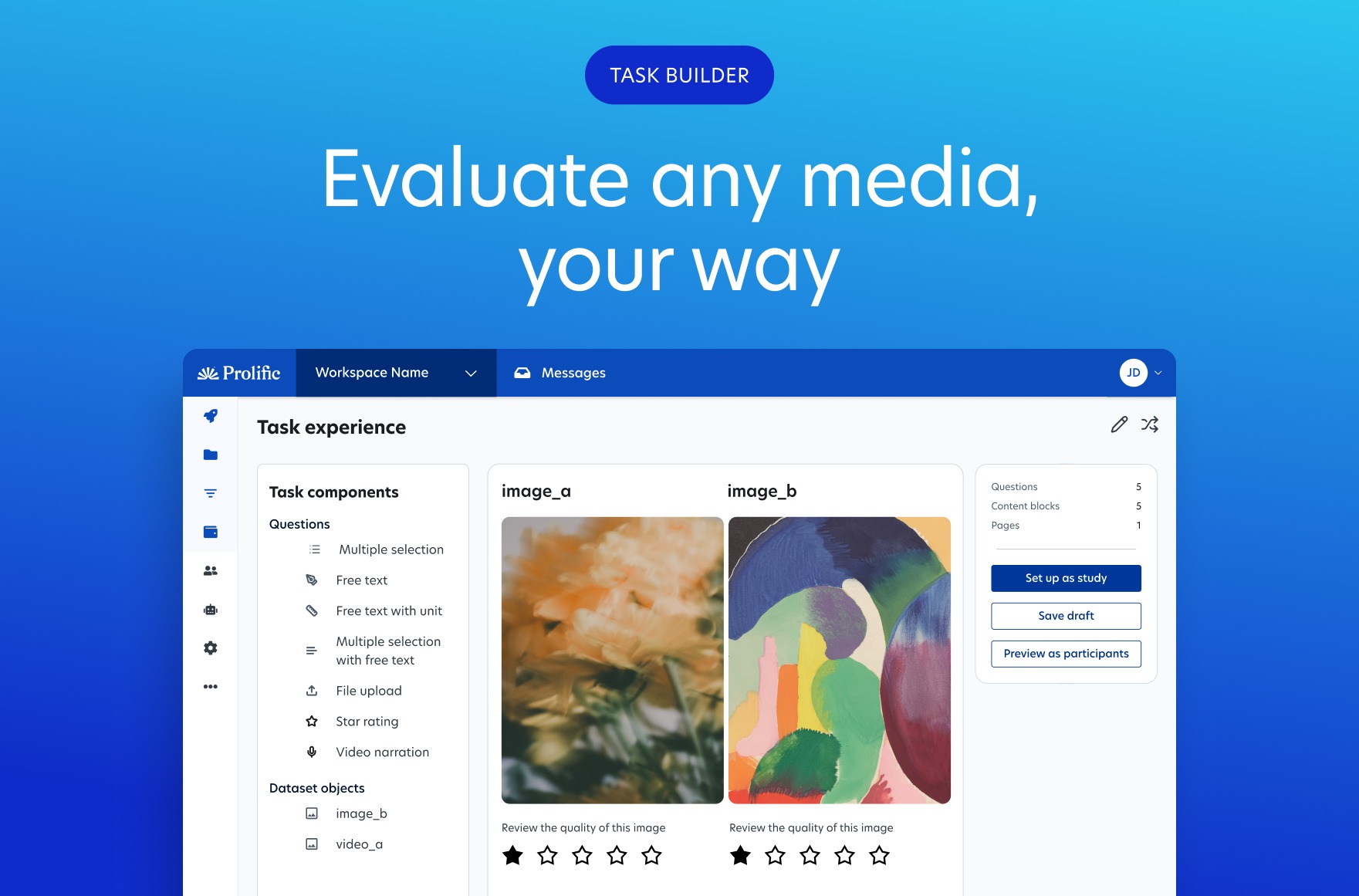
Prolific’s updated Task Builder brings participant recruitment, media presentation and structured responses into one workflow. Its November 16 release covers text, images, audio and video through an editor, API and CLI. That can reduce the engineering needed to collect human judgments. It does not remove the methodological choices that determine what those judgments actually mean.
A more accessible collection workflow
The Prolific announcement describes side-by-side comparisons, native media playback, frame-level video feedback and in-browser recording. It says teams have run around 3,000 studies through the product in six months. That reported activity shows use of the platform, rather than a controlled measure of the quality of every study or the representativeness of its participants.
The interface can help preserve context. A response tied to a particular video frame is more informative than an unlocated comment about a long clip. Structured associations between files, tasks and participants can also reduce reconciliation work. These advantages concern collection and traceability; they do not make a subjective preference equivalent to an objective correctness label.
Decide what the judgment represents
A study should distinguish preference, perceived quality and task success. A participant may prefer a fluent answer that contains an error, or dislike an accurate answer that is difficult to use. The rubric should identify the property being measured and, where necessary, use separate questions rather than forcing several dimensions into one score.
Participant selection matters just as much. General audience feedback may be appropriate for a consumer experience, while a specialized factual task may require domain expertise. Verification of participant identity does not establish expertise in every subject. The evaluation should state which qualifications were used and what populations the results can reasonably describe.
Media presentation can introduce its own variation. Audio devices, display size, playback settings and accessibility needs may affect judgments. A study does not always need to eliminate these differences, especially when they reflect real use. It does need to record enough context to understand whether they explain disagreement or limit comparison between conditions.
Programmatic study creation is especially useful when it carries a versioned rubric, sampling plan and response schema. Reusing the same interface without tracking those elements can create an illusion of comparability. A change in the task wording or participant mix may alter results even when the model remains unchanged.
Build review into the collection process
Quality controls should include task comprehension and review of unusual response patterns. Prolific describes authenticity checks, but vendor testing of those checks should remain labeled as such. It does not establish that every response in a future study is human, attentive or correct. Study owners still need an approach to incomplete, inconsistent and low-information judgments.
Disagreement can be informative rather than simply noise to remove. Different users may interpret a requirement differently or value different aspects of an output. A useful analysis separates genuine diversity of preference from misunderstanding of the task. That can lead to a better product decision than reporting a single average score without context.
Task Builder’s release establishes a broader collection and evaluation surface with useful automation options. The next meaningful evidence is a reproducible study showing how participants, examples and rubrics lead to a defensible conclusion. Faster access to judgments becomes valuable when the team can explain precisely what those judgments support.
Sources and media credits
Prolific’s Task Builder release artwork. Product illustration, not evidence that every collected judgment is correct. Image: Prolific