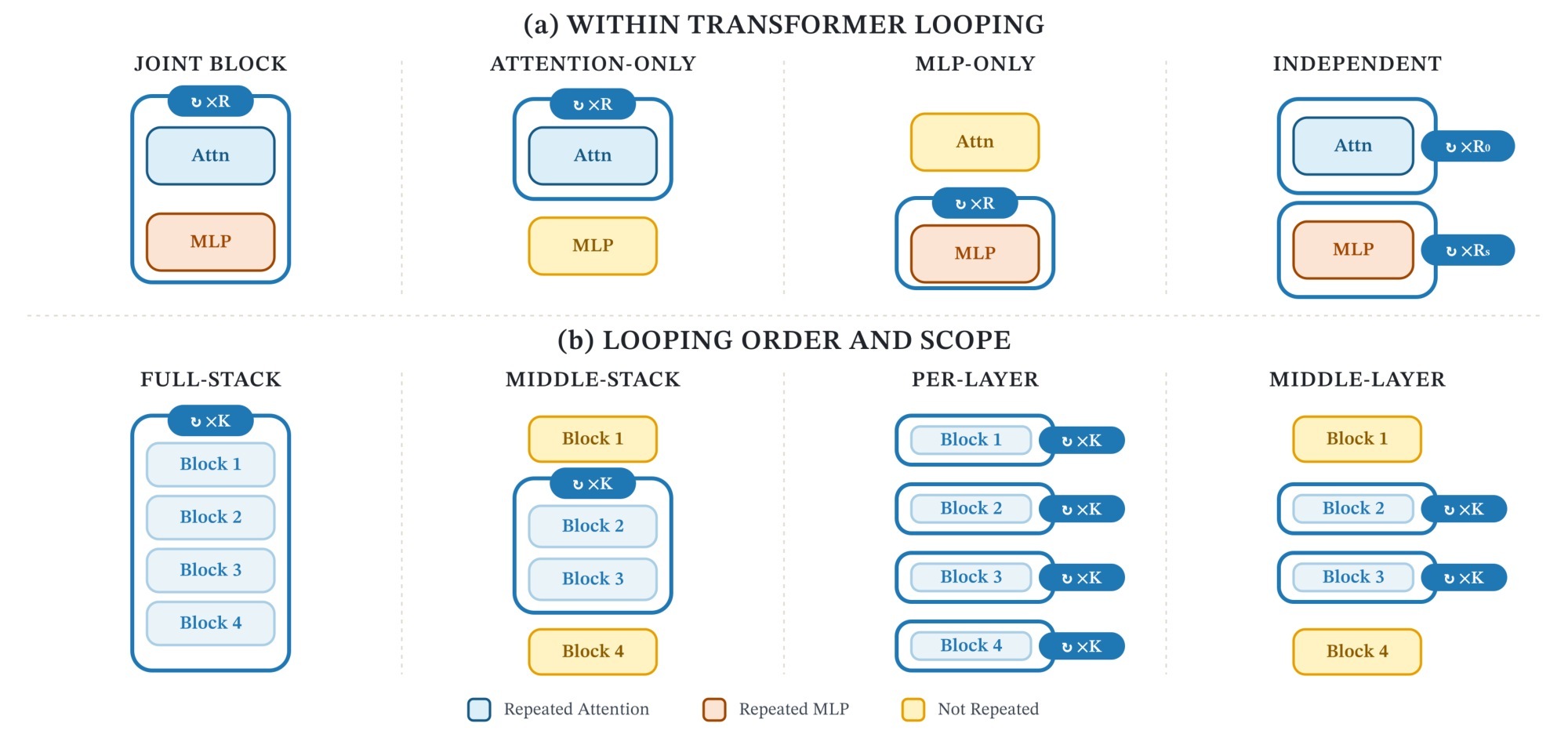
Reusing a neural network’s weights can make a small model behave like a deeper one. The stored parameter count stays small, but the machine still has to perform the extra computation, and an interactive user still waits for the result.
An October 29 preprint by Meta researchers studies loop scaling, specialization and parallel inference in transformers. The authors find different designs preferable under fixed parameter and training-compute budgets. Small loop-specific low-rank adapters relax exact weight sharing. Modified Parallel Loop Transformers preserve current-token information and separately normalize it and shifted hidden-state input, improving the tested parallel formulation. These are controlled architecture comparisons, not a claim that more loops always improve a model. Read the primary source account.
The budget determines which design wins
Looping the full transformer generally gives stronger quality at a fixed parameter budget in the reported experiments. Looping a middle block offers a different return when training FLOPs are constrained. The distinction is central: one comparison asks how much capability fits in stored weights, while the other asks how much can be learned for a quantity of computation. They are not interchangeable definitions of efficiency.
The study also reports saturation, reversal or instability as loops increase. Exact sharing forces later iterations to use the same transformation even though they receive already-transformed representations. Giving each loop a small specialized adapter changes that constraint while retaining shared main weights. It introduces another configuration choice, rather than making loop depth a cost-free setting.
Parallel decoding changes available information
Ordinary loops execute sequentially for each generated token. Parallel Loop Transformers shift communication between loops across adjacent token positions so stages can run together. That rearrangement changes what a stage knows when it computes. The paper’s modifications address this information boundary by retaining the current token’s embedding and normalizing the combined inputs separately.
The immediate contribution is a more explicit design space for teams investigating recurrent computation. A useful reproduction should name the parameter, training and decoding budgets, rather than advertise a single efficiency ratio. It should also preserve the model scale and training-token regime used to obtain that ratio, since a favorable design in one regime need not dominate another.
Weight reuse could make capable models easier to store and distribute if the additional computation remains acceptable. Parallel execution could improve that tradeoff, provided it retains useful information and quality. The next evidence to watch is latency and downstream performance measured together on a representative serving workload, rather than parameter savings presented as an automatic user-visible speedup.
Source organizations: Meta.
References
Questions, news tips or corrections? Contact [email protected].