An intermittently used model can be expensive even while it is waiting for work. For a service with bursts of short decisions, the cost of keeping a replica available may matter as much as its peak token throughput. This changes the hardware question: the best option is the one that meets the actual response requirement at the expected traffic pattern, rather than the machine with the largest headline generation rate.
League’s October 29 engineering account examines DiffusionGemma 26B-A4B in BF16 on two Intel CPU configurations using vLLM. The team changes eligible structured reads from two engine steps to one. It reports an 18.8 percent latency reduction at concurrency one on its C4 setup, with smaller throughput and per-decision cost gains at higher concurrency. The optimization remained under review when the account was published; prerequisite CPU fixes were already merged. Read the primary source account.
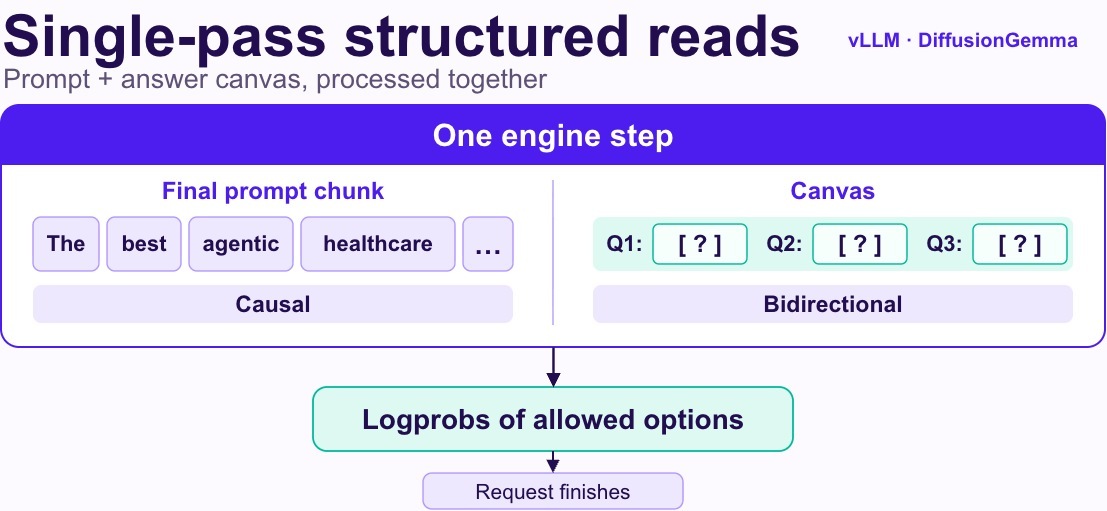
The answer template is already known
A structured read scores predefined options in a supplied answer template. That differs from generating a free-form response whose later tokens depend on earlier choices. League identifies an execution path that separated prompt processing from scoring the template, even though the template was available when the request arrived. The optimization places that scoring work with the final prompt chunk for requests satisfying the stated eligibility conditions.
The distinction prevents an overbroad interpretation. A faster path for one-step reads does not establish an equivalent improvement for ordinary text generation or every diffusion request. Developers considering the change should first determine how much of their traffic actually uses the eligible form. A substantial local gain can become a small service-wide gain if the relevant requests occupy only a minor part of the workload.
Capacity prices and work prices answer different questions
The account separately compares the monthly cost of continuously available CPU and GPU replicas. Those October prices describe a region and configuration, not a permanent universal ranking. A lower standing bill can be attractive at low utilization while a different machine remains preferable under sustained load. The comparison needs both the expected arrival pattern and the latency requirement; monthly replica cost alone cannot determine which setup supports the service reliably.
Queueing is particularly relevant when arrivals are uneven. A configuration that responds promptly to one isolated request may accumulate delays during a burst. Throughput at several concurrency levels helps characterize that behavior, while a production decision also needs the chosen service objective and realistic request lengths. The useful comparison is the capacity required to meet that objective, including quiet intervals, rather than a ratio between unrelated benchmark maxima.
Similar accuracy can conceal changed answers
League reports no statistically significant aggregate JevBench accuracy change, while individual decisions did change. It also observed more changed decisions when moving between the two CPU configurations than when applying the optimization. That is a consequential qualification for decision services: equal aggregate scores can describe systems that disagree on specific inputs. The organization receiving an answer may care deeply about which inputs moved across a decision boundary.
A rollout evaluation should therefore retain disagreements as well as the final accuracy figure. Cases near a probability threshold can be examined separately from confident decisions, and the same prompt, options and model configuration should be preserved for comparison. This does not establish that the changed answers are harmful. It establishes that performance regression testing and decision-behavior regression testing answer different questions and both belong in the deployment record.
The probability interface creates another acceptance question. A consumer of the model may use a threshold, select the highest-scoring option or send uncertain cases for review. Those policies can react differently to a small probability change even when the top answer stays fixed. A complete regression check should retain the downstream decision rule, so that changes in numerical output can be connected to actual service behavior. Otherwise, the team may measure agreement at the model boundary while overlooking a changed action further along the workflow.
The immediate contribution is a concrete serving optimization and an unusually useful account of the trade-off between always-on cost, latency and decision stability. Its wider significance is methodological: small implementation details can matter when each request contains little work, while hardware changes can alter more than speed. The next evidence is the reviewed upstream implementation and reproducible application tests showing that the selected CPU configuration meets both response-time and decision-quality requirements at real traffic levels.
Source organizations: League.
References
Questions, news tips or corrections? Contact [email protected].