A person recording a task supplies a view of useful behavior without automatically supplying the robot’s joint states, balance information or control commands. That missing information is a central difficulty in learning from human experience. The video can show where an object moved while leaving unresolved how a different body should reach it. Scaling the amount of footage does not, by itself, solve that mismatch between observation and control.
The HuGe paper, posted October 25 by researchers including Westlake University, investigates a training corpus of more than two thousand hours of egocentric human and robot experience. Its contribution includes creating pseudo-proprioceptive states through simulation playback and adapting the appearance of arms in downstream observations. The authors evaluate existing vision-language-action architectures with a whole-body control interface, rather than presenting a new robot or an unrestricted general-purpose deployment. Read the primary source account.
A data transformation also creates assumptions
Proprioception describes a machine’s information about its own physical state. A human video does not directly contain the corresponding robot values. Constructing them makes the experience compatible with a training interface, but the constructed record must not be mistaken for a measurement taken from the eventual machine. Its usefulness depends on whether the transformation preserves the aspects of movement that the policy needs for the selected task.
The paper combines egocentric pretraining, humanoid adaptation and downstream fine-tuning. That staged arrangement recognizes that a large source of human experience and a smaller set of machine-specific demonstrations play different roles. A comparison should therefore retain the composition of each stage. Otherwise, an improvement attributed to more human footage might also reflect changes in robot adaptation or task-specific supervision.
Visual embodiment is part of the input distribution
Re-rendering arm regions addresses a different mismatch: the policy sees a different kind of body during training and deployment. Making that change explicit helps separate a visual adaptation from an improvement in underlying control. For another research team, the relevant question is whether the adaptation remains useful when appearance, viewpoint or task geometry changes. A successful transformation on the selected examples does not establish that every visual difference has been removed.
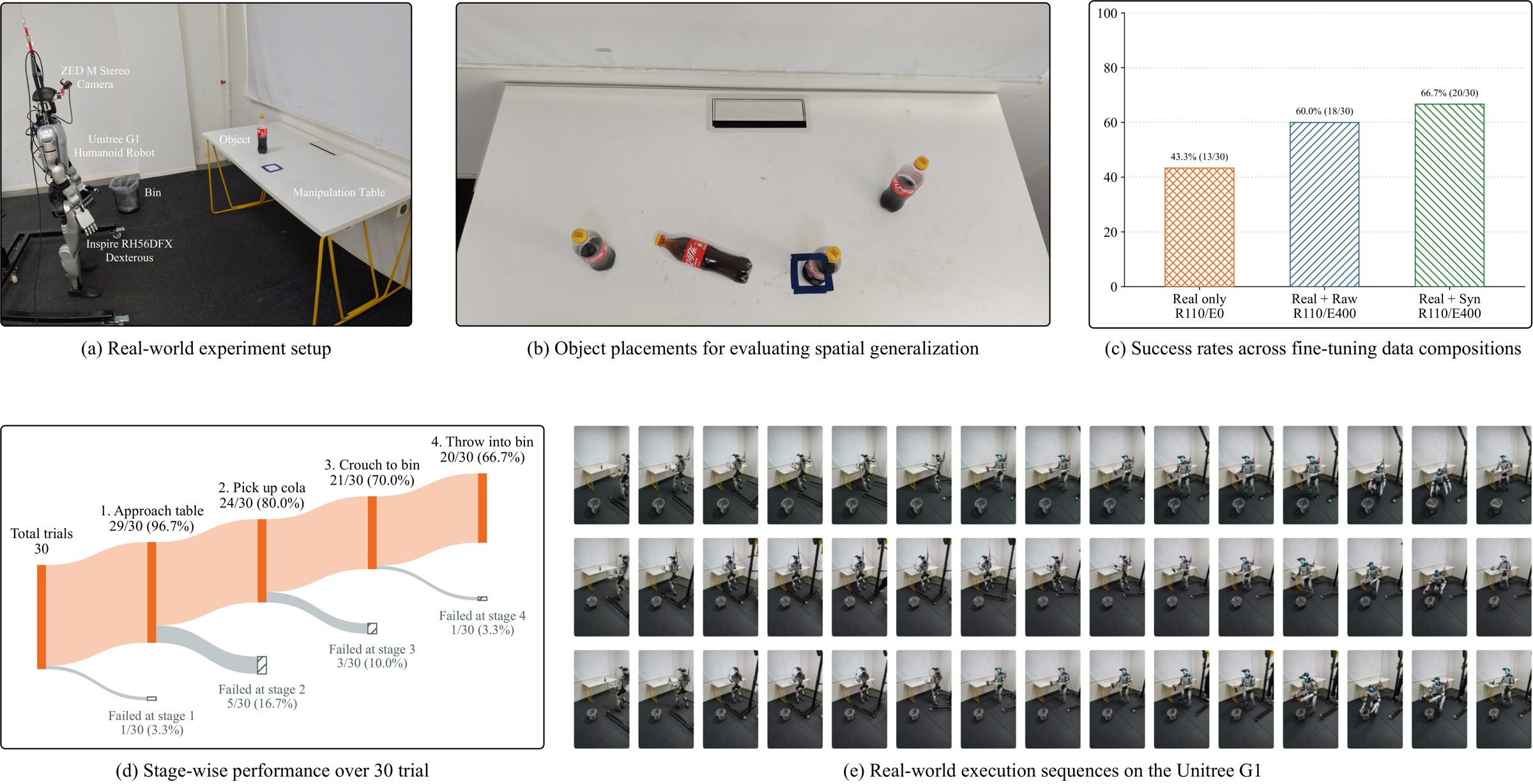
The authors report strong results on HumanoidArena and a physical Unitree G1 pick-and-drop evaluation. Those are different evidence settings. Simulation can provide controlled comparisons across many trials, while the physical experiment tests a narrower connection to actual hardware. Neither should be substituted for the other. In particular, a result on a selected manipulation task cannot establish general household reliability or readiness for unsupervised operation.
Dataset scale needs an account of diversity
Hours are a useful description of collection scale, but they do not reveal how many materially different decisions the policy encounters. Repeated examples of a familiar motion can contribute differently from examples involving new contacts, objects or recovery situations. A reusable data account should explain which behaviors the mixture supplies and how the task-specific evaluation differs from them. That would make the claimed transfer easier to interpret than the total duration alone.
The hierarchy between a task-level policy and a whole-body controller also affects the conclusion. Good task predictions depend on a controller that can execute them while maintaining physical stability. When comparing approaches, researchers need to know which component changed and which remained fixed. Otherwise, an apparent gain in visual understanding could be entangled with a change in the motion interface or the capabilities already supplied by the lower-level system.
Data provenance also remains useful after adaptation. A transformed example should retain a reference to its source and an explanation of which fields were observed, inferred or rendered. That lets an independent team examine whether an error follows the source demonstration or the adaptation stage. It also prevents a synthetic robot-state field from acquiring the apparent authority of a physical sensor measurement merely because both occupy the same column in the final training dataset. The distinction is essential to understanding what the additional hours contribute.
For developers, the immediate value is an explicit recipe for making human experience usable by a humanoid learning pipeline. It offers transformations that can be examined and ablated instead of treating a mixed dataset as an unexplained ingredient. The broader opportunity is to reduce dependence on costly machine-specific demonstrations. That opportunity remains conditional on transfer: the next persuasive evidence would show which data transformations continue to help across robots, tasks and physical conditions, with failed transfers retained alongside the successful examples.
Source organizations: Westlake University.
References
Questions, news tips or corrections? Contact [email protected].