A company’s evidence rarely lives in one format: a relevant detail might be in a document, a photograph, a recording or a few seconds of video. An assistant that searches only the text can miss the material that would change its answer. Google’s EmbeddingGemma 2 addresses that earlier search problem, before a chatbot begins composing a response.
Google released EmbeddingGemma 2 on October 6, extending its compact embedding-model line from text into images, video and audio. The model maps different inputs into a shared numerical space. That is a different kind of advance from a chatbot producing better answers: it changes how a system finds the evidence that an answering model will use.
The launch post describes a 740-million-parameter model designed for local use. The model card identifies a unified 768-dimensional representation for text, code, images, video and audio. Independent coverage in SiliconANGLE highlights the move beyond the first version’s text-only scope.
One search can reach different kinds of evidence
An embedding is a numerical description of an item, such as a document or image. It is useful because distance in its numerical space can help identify related material. A text query can locate a relevant document without requiring an exact keyword match. Extending the same idea across media can let a spoken request retrieve an image or identify a moment in a video.
Putting different media in one searchable space can remove some handoffs between separate systems. Today a team might caption an image or transcribe a recording before searching it as text. A shared representation offers another route to the match. Captions and transcripts can still help; the new option matters where they omit the visual or acoustic detail a user needs.
Similarity is not a universal property
Two pictures can be similar in appearance while showing different objects that matter to the task. Two recordings can contain the same words but convey different speakers or conditions. A general embedding model must compress many such distinctions into a limited representation. Whether it keeps the right distinctions is an empirical question.
Consider a hypothetical maintenance archive containing photographs of near-identical components. A broad semantic search for a damaged valve may retrieve plausible images, but the user may need the correct part revision and failure type. The system must distinguish task relevance from visual resemblance. A strong general benchmark does not eliminate that domain-specific test.
The downstream model cannot repair missing retrieval
Our assessment is that embedding quality deserves more attention in discussions of grounded AI. A capable answering model can reason over retrieved evidence, but it cannot reliably cite an essential record that was never found. Retrieval failures can therefore resemble reasoning failures unless the evaluation records what information each stage received.
This suggests evaluating the representation before optimizing the final answer. Test whether relevant items appear within the retrieved set, how high they rank and which misleading neighbors displace them. Then evaluate whether the answer model uses the right evidence. These are connected measurements, but they diagnose different problems.
Small enough to move closer to the data
A compact model also changes where this work can happen. Local processing can reduce the need to transfer raw media for every search. That may be valuable for intermittent connectivity or tightly controlled data, although local execution alone does not establish a complete privacy or security guarantee.
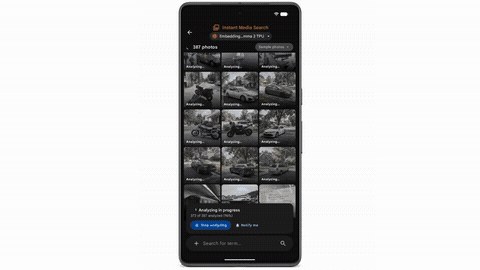
The engineering question is the full retrieval pipeline: media decoding, segmentation, embedding generation, storage and search. A model fitting into a device’s memory does not mean that a large archive can be indexed instantly or without energy cost. Companies should measure first-time indexing separately from repeated queries and account for updates when new material arrives.
Local retrieval changes where evidence travels
Compare search across different media types against a strong text-caption or transcription baseline on real, held-out tasks. Include difficult near-matches, indexing time and on-device resource use. The meaningful advance would be more relevant evidence found with a simpler or more economical pipeline—not merely more media types listed on the model card.
A reliable way to search across media could make more of an organization’s existing knowledge usable. The gain is better access to evidence people already have, provided the system preserves the distinctions their decisions depend on.
References
Questions, news tips or corrections? Contact [email protected].