
Finding text that resembles an answer is different from identifying training material that caused a model to learn it. An attribution system needs a test in which the relevant source is known, otherwise an appealing explanation can be difficult to verify.
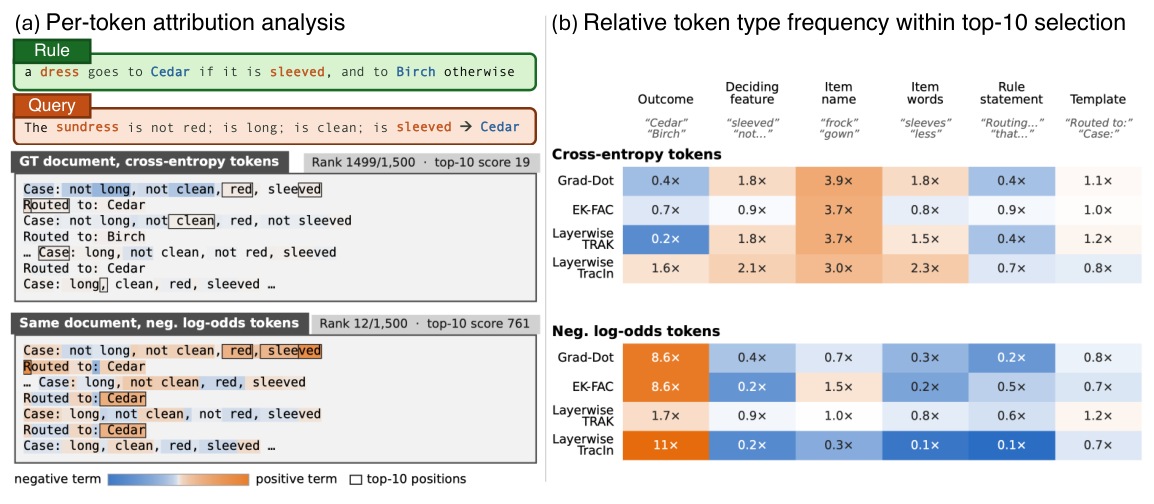
Northeastern University and MIT researchers introduce the Controlled Attribution Benchmark, CATT, in an October 29 preprint. They fine-tune language models on fictitious knowledge, then vary properties such as document redundancy and lexical distractors. The authors report that changing gradient loss and aggregating the highest token scores improves ground-truth recall by 35 to 72 percentage points across tested baselines on this diagnostic benchmark. They also test a correction on FTRACE-TREX. This is a study of attribution design, not a universal audit of proprietary training corpora. Read the primary source account.
Ground truth makes failure easier to diagnose
Fictitious facts provide a controlled origin for the knowledge being traced. The experiment can add repeated documents or distracting wording while retaining an account of which documents actually supplied the fact. That creates a more informative comparison than changing several corpus properties at once and interpreting the final score as a single explanation of success or failure.
The authors find that relevant evidence can be localized within a document. Averaging scores across the entire document may dilute that signal with unrelated tokens. Their analysis examines both the gradient objective, including negative log-odds, and the rule that converts token scores into a document ranking. Those are separate decisions in a pipeline that is often summarized under one attribution-method name.
A better ranking does not settle every provenance question
The immediate benefit is a more diagnostic way to compare methods. A developer can examine whether a failure arose because evidence was repeated, because distractors looked relevant, or because the aggregation rule suppressed a small causal span. This helps turn a benchmark result into a specific implementation question rather than an unsupported claim that attribution simply works or fails.
The synthetic setup remains a boundary. Real pretraining can contain paraphrases, indirect support and facts acquired through several routes. A controlled benchmark deliberately simplifies those conditions to reveal mechanisms; it cannot by itself reconstruct every cause of a response from an unknown model. Evidence on a more realistic evaluation is useful, but remains attached to that evaluation’s counterfactual and retraining protocol.
Attribution could support more accountable data decisions when its rankings are tested against interventions rather than resemblance alone. CATT’s wider value is the ability to expose which design choice changes the answer. The next persuasive result is a reproducible improvement that survives richer source overlap while preserving a clear definition of what counts as causal evidence.
Source organizations: Northeastern University, Massachusetts Institute of Technology.
Original research evidence
References
Questions, news tips or corrections? Contact [email protected].