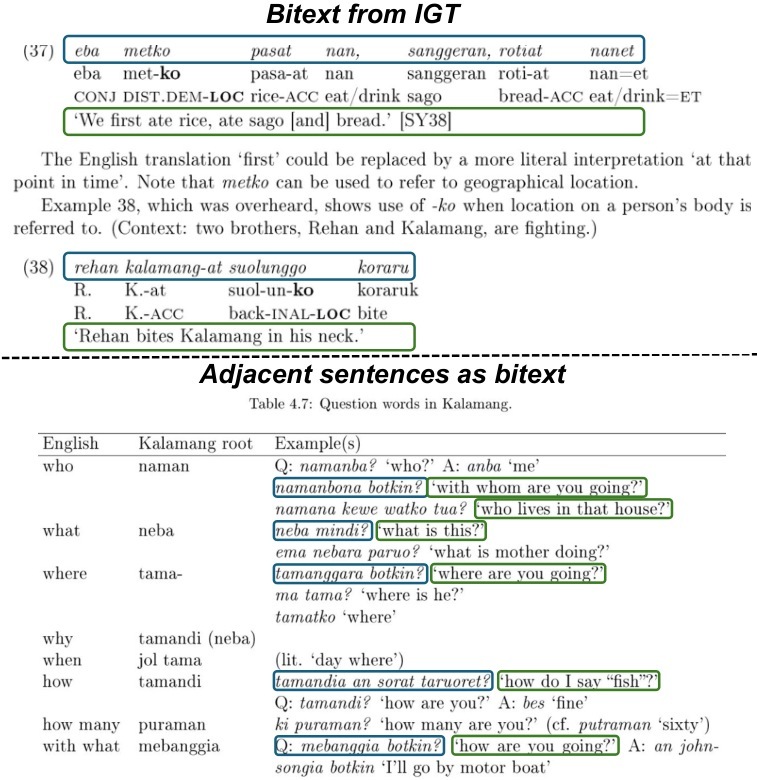
A language can have substantial written documentation without enough parallel web pages to train a useful translation system. Grammars and dictionaries contain examples, but extracting the right pairing requires understanding the page as well as recognizing its characters.
An October 29 preprint by George Mason University and Barron Associates researchers develops a pipeline combining optical character recognition and a vision-language model to extract bitext from archival linguistic documents. The study evaluates translation across twenty languages using both trained translation models and in-context examples. It reports average chrF2++ improvements of 15.78 and 6.94 over zero-shot translation into low- and high-resource languages respectively in its in-context setting. Code and extracted data are released with the work. Read the primary source account.
Layout carries part of the alignment
A page may place an example beside a translation, below a gloss, or within a dictionary entry. Recognizing all the words does not identify which strings should become a training pair. The pipeline uses visual layout to preserve those relationships. This addresses a different source of error from simply improving OCR accuracy on isolated lines.
The resulting resource is smaller than the web-scale corpora available for widely represented languages. Its point is to recover useful examples where those corpora are missing. The reported averages remain tied to the evaluated documents, extraction process, models and translation directions; they should not become a promise of equivalent gains for every underrepresented language.
Extraction quality becomes model quality
For practitioners, the immediate option is to inspect a released route from documentation to paired examples. A useful adoption check would sample extracted pairs against the original pages and retain the document location. That makes it possible to distinguish translation-model errors from failures introduced during recognition or alignment. This is an evaluation implication of the pipeline, not a claim that every released pair has been independently checked.
Access also carries a provenance question. An old document’s availability does not automatically establish unrestricted rights over every component, and language communities can have interests in how their records are reused. A receiving project should preserve source and licensing information rather than treating extraction as a step that erases the origin of the material.
The broader opportunity is a data strategy that starts with the resources a language actually has. It could expand practical translation work beyond the languages well represented on the web, provided extraction quality and community context remain visible. The next evidence to watch is performance on additional document styles and languages with audited alignment errors, rather than a language-count target alone.
Source organizations: George Mason University, Barron Associates.
References
Questions, news tips or corrections? Contact [email protected].